
Fewer new RVs are rolling onto dealer lots this year, and the slide got steeper as the year went on. Through August, manufacturers shipped 207,191 RVs, down 14.2% from the same point in 2025 (RVIA via Modern Campground), and the industry’s own forecasters now expect 2026 to finish around 290,000 units (RV RoadSigns via RV PRO).
We dug into ten years of shipment data, this year’s quarterly and monthly numbers, and what dealers and manufacturers are saying, to explain why sales are falling and what that means if you’re shopping for a camper.
In this storyBy year By quarter Why sales fell For buyers Where the numbers come from
2026 at a glance
The numbers that matter
- Wholesale shipments, January to August: 207,191 RVs, down 14.2% (RVIA)
- New RV retail registrations, January to May: 113,631, down 16.4% (Statistical Surveys via RVBusiness)
- Used RV registrations, same period: 284,744, up 2.4% (Statistical Surveys)
- Full-year 2026 forecast: about 290,000 shipments, down 15.3% from 2025 (RV RoadSigns)
Wholesale vs. retail: shipments count RVs sent from factories to dealers, and registrations count RVs that buyers actually titled. Shipments react faster because dealers cut orders as soon as they see lots filling up.
RV sales by year
The long view: a boom, a bust and a second dip
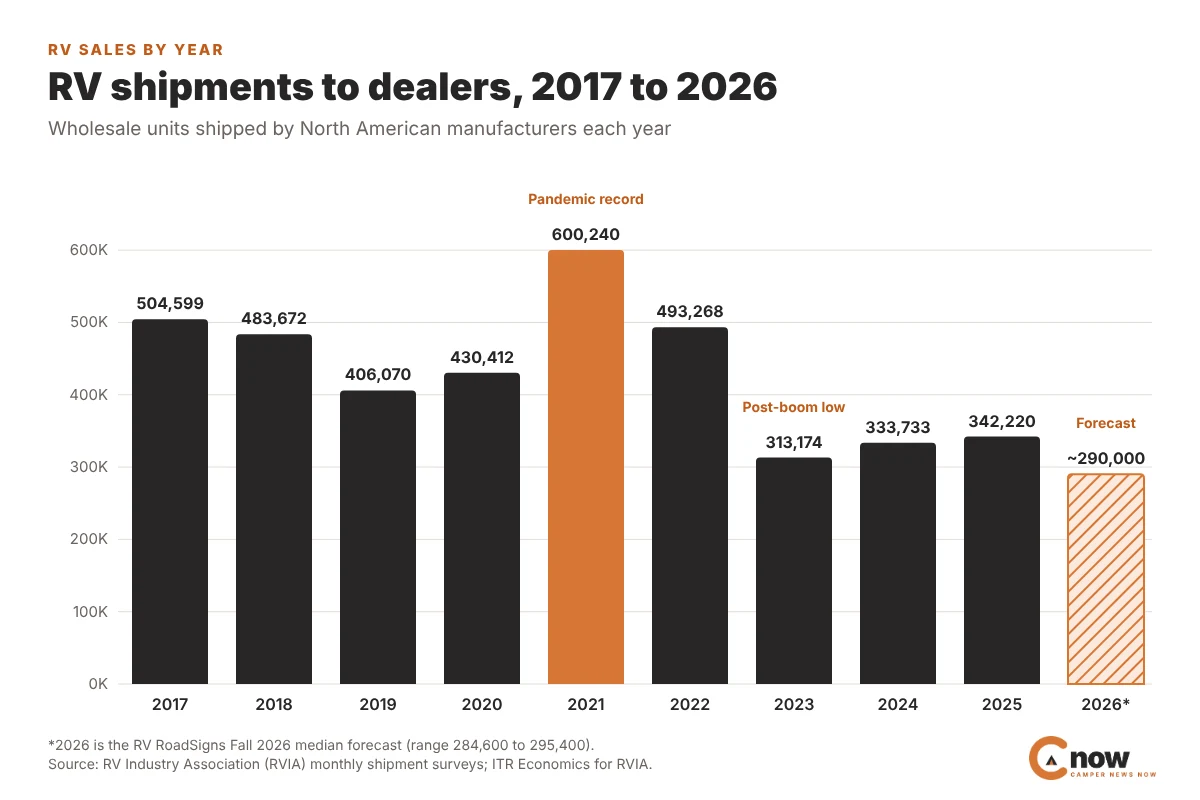
Before COVID, the industry shipped between roughly 400,000 and 500,000 RVs a year, with 2017’s 504,599 the record at the time (RV PRO). Then camping became the safest vacation in America. Shipments reached 430,412 in 2020 despite a nearly two-month factory shutdown (RVIA), and 600,240 in 2021, an all-time record (RV PRO).
The hangover came fast. Shipments slipped to 493,268 in 2022 (RVIA) and fell 36.5% to 313,174 in 2023 as dealers worked through crowded lots and rising loan rates (RV News).
2024 and 2025 looked like a slow recovery: 333,733 units in 2024, up 6.6% (RVIA), and 342,220 in 2025, up 2.5%, worth about $20.4 billion at retail (RV PRO, RV News). That recovery has now reversed. If the 290,000 forecast holds, 2026 will come in below even the 2023 low.
Why it matters: the post-pandemic reset is over, and this is a new downturn driven by the economy, not by leftover inventory from the boom.
RV sales by quarter
Quarter by quarter, the slide deepened in peak season
2025: a fast start, then flat
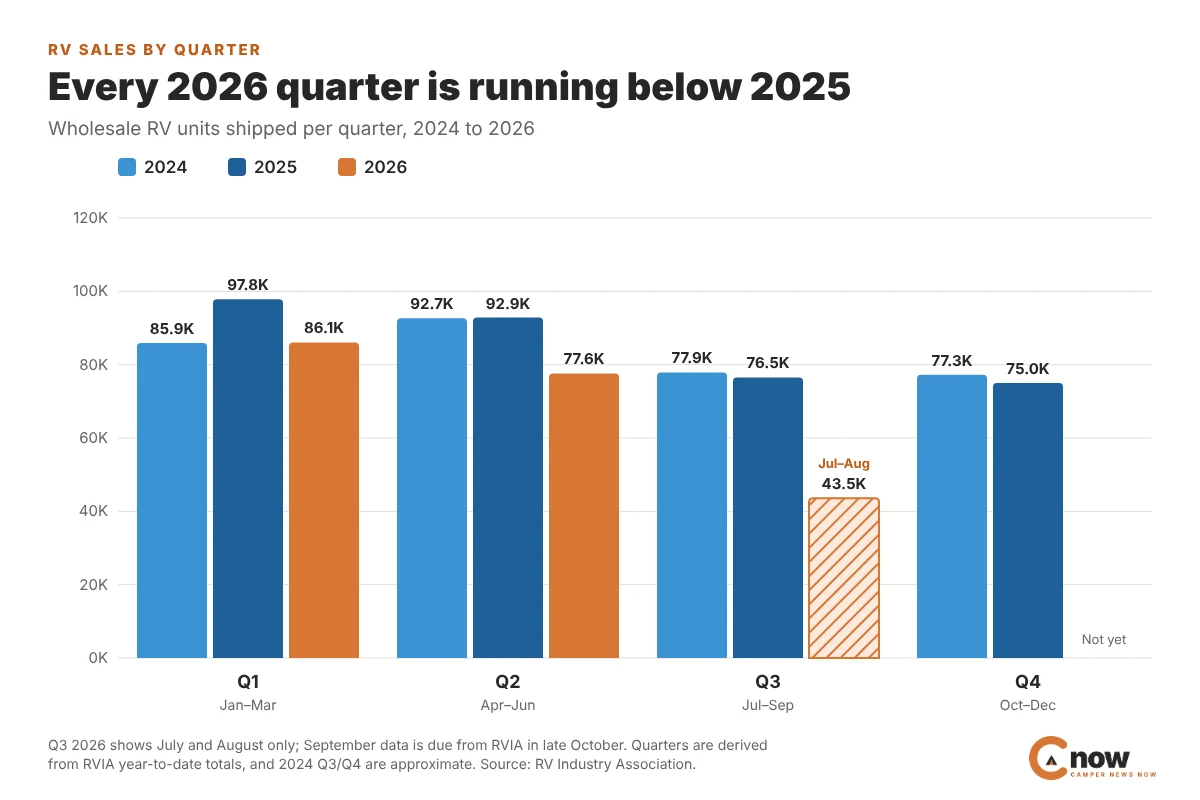
The first quarter of 2025 jumped 13.9% to 97,848 shipments (RVIA). Much of that was dealers buying ahead of new tariffs (Inside Indiana Business). In Canada, dealers pulled orders forward to beat expected retaliatory tariffs (CRVA via RV PRO). After that rush, the rest of the year was flat. The second quarter finished about even with 2024 at 92,857 units (RVIA), and the third quarter was down 1.7% at 76,529 (RVIA).
2026: down every quarter
The first quarter of 2026 fell 12.1% to 86,051 units (RVIA). That’s partly a tough comparison with the tariff rush of early 2025, but the decline kept growing. The second quarter, which includes the spring selling season, fell 16.4% to 77,593 (RVIA).
July and August together came to 43,547 shipments, about 14% below the same two months of 2025 (RVIA, Modern Campground). September’s numbers are due from RVIA in late October.
Not every type of RV is falling
- Travel trailers and fifth wheels are driving the decline. Towables were down 16.8% through June (RVIA), and THOR’s fifth wheel shipments fell 34.7% in its May to July quarter (THOR Industries).
- Motorhomes were up 9.8% through June, then fell 25.6% in July (RVIA, RVIA).
- Park model RVs, the small cabins sold to campgrounds and resorts, are the bright spot, up about 24% for the year through July (RVIA).
What’s behind it
Why RV sales are falling in 2026
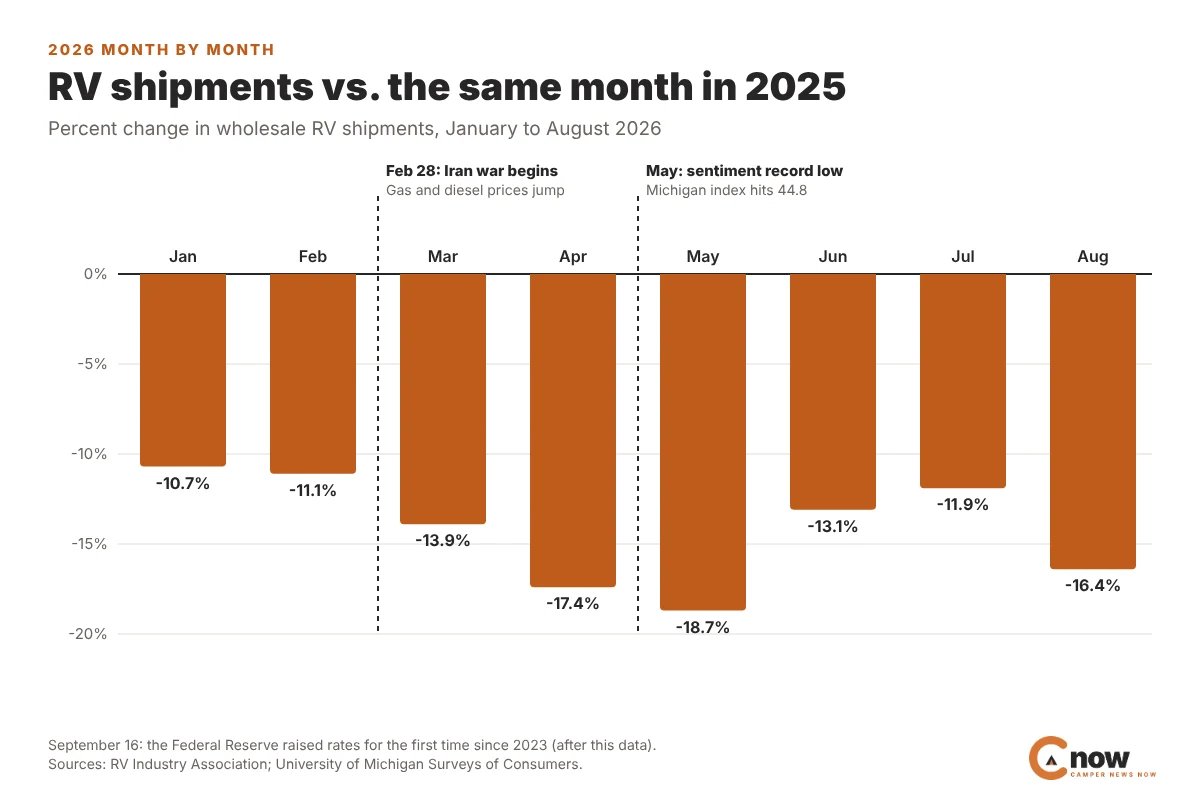
The year started soft, with January down 10.7% and February down 11.1% (RVIA, RVIA). The declines got bigger after the war with Iran began at the end of February, reaching 17.4% in April and 18.7% in May, the heart of the buying season (RV PRO). RVIA’s CEO pointed to persistent inflation, high interest rates, higher fuel prices, geopolitical uncertainty, and more cautious ordering by dealers (RV PRO).
Fuel prices jumped
Gas averaged $4.33 a gallon nationally in mid-October, up 45% from $2.98 on Feb. 27, the day before the war began. Diesel rose about 68%, to $6.30 (CNN, citing AAA). That raises the cost of every road trip, and it hits motorhomes and diesel tow trucks hardest.
Why it matters: fuel is a cost buyers can see every time they fill up, so it weighs on the decision to buy a bigger rig.
Borrowing got more expensive
On Sept. 16, the Federal Reserve raised its benchmark rate by a quarter point, to 3.75% to 4%, its first hike since 2023, and officials signaled another increase is likely this year (CNBC). Many buyers finance an RV, so higher rates mean bigger monthly payments. THOR’s CEO named stubborn interest rates, fuel costs and inflation as the strain on household budgets (THOR Industries).
Shoppers feel worse about the economy
The University of Michigan’s consumer sentiment index fell to a record low of 44.8 in May (Scripps News) and was at its second-lowest reading on record in September (CNN). Moody’s estimates the war has cost the average household about $2,000 in higher prices (CNN). An RV is a want, not a need, and it’s one of the first big purchases families put off.
Dealers are ordering cautiously
Dealers don’t want to finance lots full of unsold trailers, so they’re ordering less. THOR says independent dealer inventory was down 11.5% from a year earlier (THOR Industries). Camping World, the largest RV dealer, chose to clear out aged and prior-model-year units after a weak May and June, and its same-store new RV sales fell 16.3% in the second quarter (RV PRO).
The bright spot: used RVs
While new registrations fell 16.4% through May, used RV registrations rose 2.4% (RVBusiness). Camping World’s same-store used unit sales grew 5.2% in the second quarter (RV PRO). People still want to camp, and many are choosing a cheaper used rig over a new one.
For buyers
What this means if you’re shopping for an RV
- Ask about leftover models: dealers are clearing prior-model-year inventory, which can mean better pricing on brand-new units that are a model year old.
- Get financing quotes before you shop: rates went up in September and may rise again, so compare a credit union or bank quote with the dealer’s offer.
- Budget for fuel: at today’s prices, a gas-hungry motorhome or a heavy fifth wheel costs noticeably more per trip than it did last winter.
- Look at used: used sales are growing because the value is there. Get an independent inspection and check for open recalls.
Our take: if your finances are steady, fall and winter of 2026 look like a buyer’s market for new towables. If you’re stretching to make the payment work, a used rig or waiting for rates to settle is the safer move.
Where we get the numbers
The five best sources for RV sales data
If you want to follow the RV market yourself, these are the sources we check, in order of how often we use them.
RV Industry Association monthly shipment reports
The official count of RVs shipped from manufacturers to dealers in North America, by type, released about three to four weeks after each month ends (RVIA Reports and Trends). Best for: the fastest read on where the industry is heading.
Statistical Surveys retail registrations
Counts of new and used RVs actually registered by buyers, by state, brand and type, usually reported a couple of months after the fact (RVBusiness coverage). Best for: what buyers are really buying, including used.
RV RoadSigns forecast
RVIA’s quarterly outlook, prepared by ITR Economics, with a full-year range and the next year’s projection (RVIA RoadSigns). Best for: where the industry expects to finish the year.
Earnings reports from THOR, Winnebago and Camping World
Quarterly results that reveal dealer inventory, pricing, used sales and what executives expect next (THOR, Winnebago, Camping World via RV PRO). Best for: the why behind the numbers.
RV trade press
RV PRO, RVBusiness and RV News cover every report above within days, and add dealer and supplier news (RV PRO, RVBusiness, RV News). Best for: one place to catch everything.
We also watch three outside signals that move RV demand: AAA gas prices, Federal Reserve rate decisions, and the University of Michigan consumer sentiment index.
Coming up
What to watch next
- Late October: RVIA’s September shipment report, which completes the third quarter (RVIA).
- Oct. 21: Winnebago’s fiscal 2026 results. With its last quarterly results, it cut its 2026 industry estimate to 290,000 to 310,000 shipments (Winnebago).
- 2027: RV RoadSigns projects about 285,000 shipments, with declines easing in the first half and growth returning in the second half (RV PRO).
We’ll update this analysis as new monthly numbers come in. If you’re keeping the rig you have and hitting the road instead, our route planner can help you find camps along the way.
Find camps along your route with QuickCamp
Paste a Google Maps directions link or type a route like San Francisco to Yosemite. QuickCamp maps the camps, hikes, Scout finds and safety conditions along the way, and saves your trips. No sign-in needed to search.
QuickCamp is made by the publisher of Camper News Now.
Sources
- Modern Campground: RV Shipments Reach 23,599 Units in August
- RVIA: July RV Shipments Near 20,000 Units
- RVIA: June RV Shipments Top 25,000
- RVIA: March RV Shipments Top 32,000
- RVIA: February RV Shipments Top 29,000
- RVIA: RV Shipments Top 24,000 in January
- RV PRO: RV Shipments Up 2.5% YOY in 2025
- RV News: RVIA 2025 Industry Profile
- RVIA: RV Shipments Up 4.4% in September (2025)
- RVIA: RV Shipments Up 15% in June (2025)
- RVIA: RV Shipments Up Nearly 14% in the First Quarter of 2025
- RVIA: 2024 RV Shipments Up 6.6%
- RV News: RVIA Forecast Projects Slight Shipment Increase in 2026
- RVIA: 2022 RV Shipments Surpass 493,000
- RV PRO: 2021 Shipments Set All-Time Record
- RVIA: 2020 RV Shipments Surpass 2019 by 6%
- RV PRO: RV Shipments Expected to Stabilize in 2027
- RVIA: RV RoadSigns Quarterly Forecast
- RVBusiness: SSI May Retail Registrations Decreased 19%
- RV PRO: Camping World Q2 2026
- THOR Industries: Fiscal 2026 Fourth Quarter Results
- Winnebago Industries: Fiscal 2026 Third Quarter Results
- CNBC: Fed Rate Decision, September 2026
- CNN: The Iran War Is Costing Households $2,000
- Scripps News: Consumer Sentiment at Lowest Level in 70 Years
- CNN: Consumer Sentiment, September 2026
- Inside Indiana Business: Tariff Uncertainty Hits RV Industry
- RV PRO: CRVA Reports Shipments Into Canada
Get the Camper News Now monthly
Closures, fee changes, recalls and new trip ideas for tent and RV campers. One free email a month.